Thus, you go long, longer, longest, on government securities, and buy not just the coupon bearing G-secs, buy even their stripped versions.
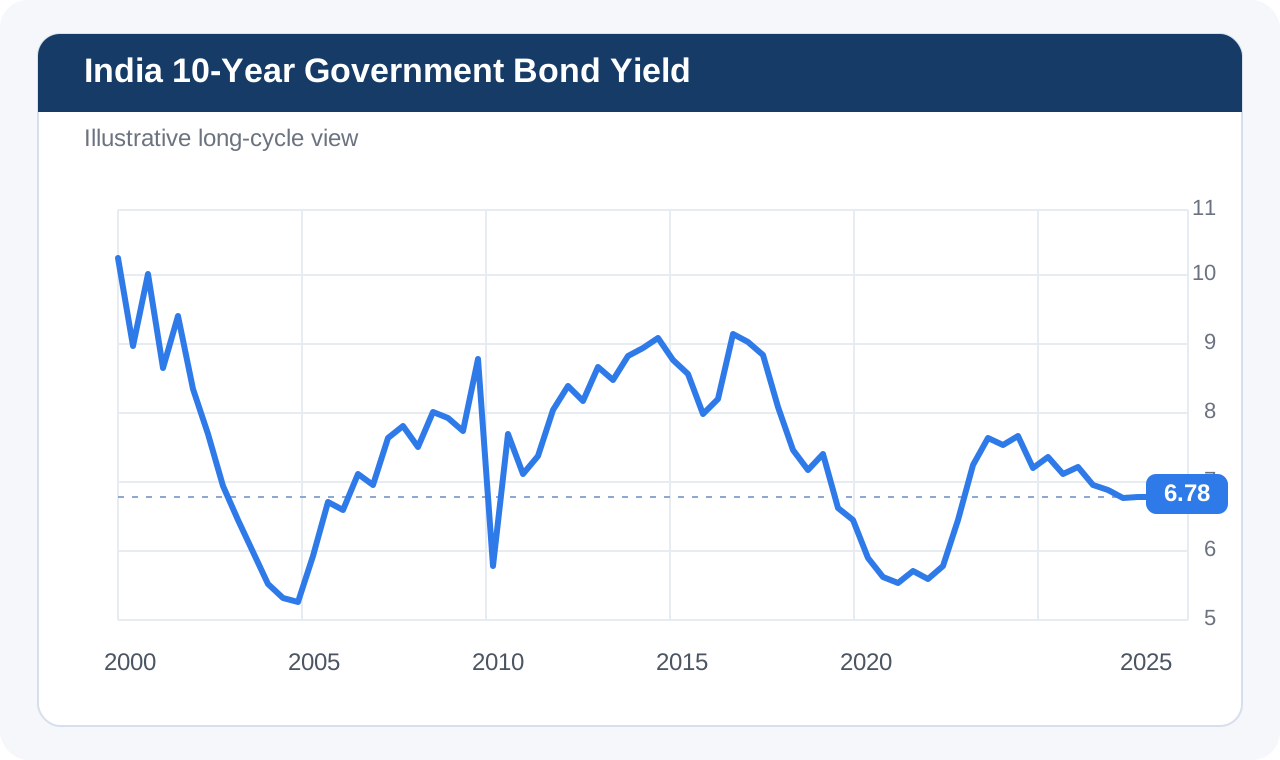
Sorry about the sing-song styled opening, but that is how it has been playing in my mind, as this theme gets played out in the wealth management circle. I got introduced to this circus very early on in my career.
In the very month I started, in Dec 1998, the first G-Sec fund got launched. The first product I started my career with. The beginning was slow. Remember it was a bull market, so all funds were going to equity. As the bubble burst, several investors started to allocate money to this product and by the end of 2000, I too had several clients invested.
Cut to Dec 2003, three years later. Their MIS was showing a return of 17-18% per annum.
How Was That Even Possible?
Let me explain with a simple example. Assume the fund had only one security in Dec 2000, a 10-year G-Sec issued at a coupon of 10%. The prevailing yield was higher at 11%, but let us assume 10%.
The yield in Dec 2003 had dropped to 5%. A drop of 5%. Assuming the fund held on to the security, the investor earned:
- 3 annual coupons of 10% each = 30%
- A capital gain of approximately 30%: as interest rates drop, the price of the security, and hence the NAV of the fund, goes up. A simple thumb rule is that every percentage drop gets multiplied by what is known as modified duration. Which for this example was 6 years. Hence, 6 years x 5% = 30%.
This implied a return of 17% per annum. Investors were ecstatic. However, then the yields started to move up, and price of security, and hence NAV, started to fall. And with every passing year, the effect of those capital gains started to get negated.
Worse, those who entered seeing these returns, actually saw very low to even negative returns. It was not easy explaining how anyone could lose money in a G-Sec fund when there was no default or delay.
But that is the nature of debt, or bond, or fixed income markets. I have always maintained it is more complex managing debt allocations than equity. So every few years when I hear such themes, I am reminded of my initiation.
So What Should One Do?
That will need a separate post. With changes in taxation, things have become trickier. But please be careful before you get sucked into such themes. Ask for track records across cycles, of the firm suggesting this. What happens after interest rates come off? One exits? And then what?
Keep in mind that a buy and hold strategy in debt has played out pretty well. Sample the 10-year returns from the following schemes:
- HDFC Short Term Fund: 7.87% pa
- HDFC Medium Term Fund: 8.08% pa
- SBI Gilt Fund: 9.39% pa
P.S. Above are only for representation purpose, similar schemes from other funds would have done similar or thereabouts.
Net net, all activity we do on our investments must, on a time and risk adjusted basis, lead to better results. Else, it is mere activity.
Disclaimer
Investment in securities is subject to market risks and investor should read all related documents before investing.
We do not guarantee performance or provide any assurance of any return.